


Vietnam Visa Guide: e-Visa Eligibility and Entry Rules
Every passport can apply for Vietnam's e-visa online, with no embassy visit needed. Citizens of around 30 countries, mostly in Europe and Southeast Asia, can also enter visa-free for a set number of days, while a smaller group still needs a visa on arrival approval letter or an embassy visa.
- e-Visa for 247 passports
- Government fee from $25
- Verified
Plusvisa is a private visa application service, not a government agency or embassy. Official government source: National Portal on Immigration (Vietnam e-Visa System), evisa.xuatnhapcanh.gov.vn.
Do you need a visa for Vietnam?
Most travellers fall into the first group below; the rest depend on your passport and travel purpose.
Which passport will you travel on?
Your route
Pick a passport
We will show the route Vietnam puts you on, the government fee for each visa type, and the guide written for your nationality.
The four routes
- e-Visa eligible
247 passports
Citizens of every country and territory can apply online for Vietnam's e-visa before travelling, through the official immigration portal, without visiting an embassy.
- Visa-free
Visa-free entry
Citizens of around 30 countries, including most of the EU, the UK, Japan, South Korea, Russia, and several Southeast Asian neighbours, can enter without any visa. How long they can stay depends on their passport.
- Visa on arrival
Visa on arrival (approval letter)
Some travellers arrange a pre-approval letter before flying and then collect a visa at the airport on arrival. This route works for air travel only, and approval must be granted before departure.
- Embassy visa only
Embassy visa required
Anyone travelling for a purpose the e-visa does not cover, such as long-term work or study, or who is otherwise not covered by the routes above, must apply for a visa at a Vietnamese embassy or consulate before travelling.
Government fees by passport
| Passport | Business trip E-visa | Tourist E-visa | Visa approval letter | Guide |
|---|---|---|---|---|
| United Kingdom | $25 | $25 | — | Read guide |
| United States | $25 | $25 | — | Read guide |
| Canada | $25 | $25 | — | Read guide |
| Australia | $25 | $25 | — | — |
| Ireland | $25 | $25 | — | — |
| Germany | $25 | $25 | — | — |
| Azerbaijan | $25 | $25 | — | Read guide |
Which Vietnam visa exists, and what it allows
| e-Visa | Options | Processing | Usual government fee |
|---|---|---|---|
| Business trip E-visaeVisa · 80 passports |
| 8–10 business days | $251 passport pays a different fee |
| Tourist E-visaeVisa · 80 passports |
| 8–10 business days | $251 passport pays a different fee |
| Visa approval lettereVisa · 167 passports |
| 8–10 business days | $220 |
How Vietnam visa fees work

Set by government, paid in USD. Vietnam's e-visa fee is set by the Immigration Department and paid in US dollars, by card, on the official government portal when you submit your application.

No refund if refused. The e-visa fee is not refunded if your application is rejected, so check every detail before you submit and pay.

Visa-free entry has no fee. Citizens of visa-exempt countries pay no visa fee at all, as long as they stay within their allowed visa-free period and purpose.

No official express fee. There is no official paid option to speed up an e-visa application. Every application goes through the same processing queue on the government portal.
What Plusvisa charges
The government fee is passed through at cost. Our service fee is on top, and every passport's page shows the total before you start.
If we make a mistake that leads to a refusal, we refund our fee and re-apply free.
See the total for my passportYour document checklist

Passport data page scan
Clear colour scan or photo of the personal details page. The passport must be valid for at least 6 months from your entry date and have at least one blank page.

Digital portrait photo
Recent photo taken looking straight at the camera without glasses, on a plain background, uploaded as a separate file from the passport scan.
Only for some travellers

Proof of onward travel and accommodation
Only if Shown only if asked by an immigration officer on arrival. A return or onward flight ticket and a hotel booking confirmation, kept ready on paper or on your phone.Pre-arrival declaration QR code
Only if All non-Vietnamese passport holders arriving by air. Completed online up to 3 days before, or on, arrival at the official pre-arrival portal, then shown to immigration as a QR code or printed form.
Not eligible for any e-Visa
Where an e-Visa is accepted
The e-visa and visa on arrival are only valid if you enter and exit through one of the official gates named on your application.
- Noi Bai (Hanoi)
- Tan Son Nhat (Ho Chi Minh City)
- Cam Ranh (Khanh Hoa)
- Da Nang
- Cat Bi (Hai Phong)
- Can Tho
- Phu Quoc (Kien Giang)
- Phu Bai (Thua Thien Hue)
- Van Don (Quang Ninh)
- Tho Xuan (Thanh Hoa)
- Dong Hoi (Quang Binh)
- Phu Cat (Binh Dinh)
- Lien Khuong (Lam Dong)
- Tay Trang (Dien Bien)
- Mong Cai (Quang Ninh)
- Huu Nghi (Lang Son)
- Lao Cai
- Na Meo (Thanh Hoa)
- Nam Can (Nghe An)
- Cau Treo (Ha Tinh)
- Cha Lo (Quang Binh)
- La Lay (Quang Tri)
- Lao Bao (Quang Tri)
- Bo Y (Kon Tum)
- Moc Bai (Tay Ninh)
- Xa Mat (Tay Ninh)
- Tinh Bien (An Giang)
- Vinh Xuong (An Giang)
- Ha Tien (Kien Giang)
- Hon Gai (Quang Ninh)
- Cam Pha (Quang Ninh)
- Hai Phong
- Nghi Son (Thanh Hoa)
- Vung Ang (Ha Tinh)
- Chan May (Thua Thien Hue)
- Da Nang
- Nha Trang (Khanh Hoa)
- Quy Nhon (Binh Dinh)
- Dung Quat (Quang Ngai)
- Vung Tau
- Ho Chi Minh City
- Duong Dong (Kien Giang)
Choose your port of arrival carefully
The application, step by step
Before you apply
- 1
Check your route and entry point
Confirm whether you can travel visa-free, need the e-visa, or need a visa on arrival or embassy visa. Choose the airport, land or sea gate you will use, since you cannot change it later.
- 2
Prepare your documents
Scan your passport data page and take a digital portrait photo that meets the official rules before you start the application.
On the official portal
- 3
Complete the online application
Go to the official National Portal on Immigration, upload your passport scan and photo, and fill in your travel details.
- 4
Pay the e-visa fee
Pay online by card on the same portal. You will get a registration code by email, which you need to check your result and print your visa.
- 5
Wait for processing
Your application is reviewed by the Immigration Department. Submitting a second application while one is pending can cause delays or confusion.
After you apply
- 6
Check your result online
Enter your registration code, email and date of birth on the e-visa lookup page to see if you are approved.
- 7
Print your visa
Print the approved e-visa, or the visa-on-arrival approval letter, to carry with your passport. Some airlines check this before boarding.
- 8
Complete pre-arrival steps
Fill in Vietnam's pre-arrival declaration before or on landing, and keep proof of onward travel and accommodation ready to show on arrival.
What your Vietnam visa looks like
Each part of the visa you receive, and what it means for your trip. Choose a label to read about it.
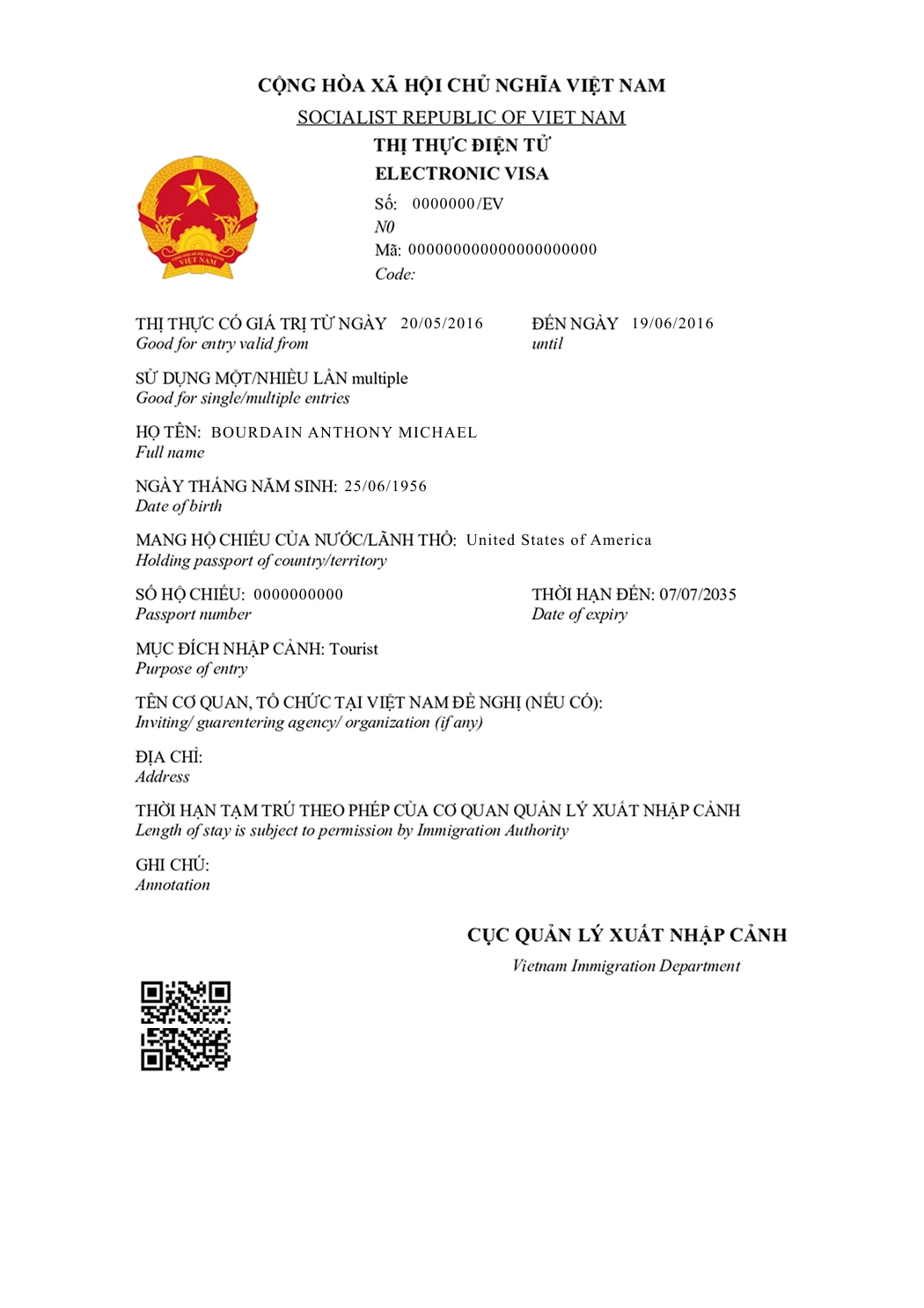
Example with fake data. Your visa will show your own details.
- 1
Country header
States that this document is issued by the Socialist Republic of Vietnam, written in both Vietnamese and English. It confirms the visa is an official government document.
- Tên nước (Vietnamese):
- Official Vietnamese name of the issuing country.
- Country name (English):
- English translation confirming the issuing country.
- 2
National emblem
The national emblem of Vietnam is printed on the visa as an official government symbol, helping confirm the document's authenticity.
- 3
Visa type & reference
Shows this is an Electronic Visa and gives two reference identifiers: the visa number and the longer code. You may need these numbers to check your visa status online or at the border.
- Document type:
- Confirms the document is an e-visa.
- Số / No:
- The unique number assigned to this e-visa.
- Mã / Code:
- A longer reference code tied to your visa application, used for verification.
- 4
Validity period
Shows the date range during which the visa can be used to enter Vietnam. In this sample it is valid from 20/05/2016 until 19/06/2016.
- Good for entry valid from:
- The earliest date you may enter Vietnam using this visa.
- until:
- The last date the visa remains valid for entry.
- 5
Entry type
Indicates whether the visa allows a single entry or multiple entries into Vietnam. This sample is marked 'multiple', meaning the holder can enter and exit more than once during the validity period.
- Good for single/multiple entries:
- You can enter and leave Vietnam more than once while the visa is valid.
- 6
Traveller details
Lists the personal and passport information used to issue the visa: your full name, date of birth, nationality, passport number, and passport expiry date. These must match your passport exactly.
- Full name:
- The traveller's full name as shown on the passport.
- Date of birth:
- The traveller's birth date.
- Holding passport of country/territory:
- The nationality/issuing country of the traveller's passport.
- Passport number:
- The passport number the visa is linked to.
- Date of expiry:
- The expiry date of the traveller's passport.
- 7
Purpose of entry
States the reason the visa was granted, which must match the activity carried out in Vietnam. Here the purpose is 'Tourist'.
- Purpose of entry:
- The approved reason for the visit; entering for other purposes may not be allowed.
- 8
Inviting organization &
Optional fields for the name and address of a Vietnamese agency or organization sponsoring the visa, if any. They are left blank here because no sponsor was used for this tourist e-visa.
- Inviting/guaranteeing agency/organization (if any):
- Name of a sponsoring organization in Vietnam, if applicable.
- Address:
- Address of the sponsoring organization, if applicable.
- 9
Stay conditions & remarks
Notes that the actual length of stay is subject to approval by the Immigration Authority at the border, and leaves space for any additional annotations, which are blank in this sample.
- Length of stay is subject to permission by Immigration Authority:
- Your actual permitted stay length is decided by immigration officers on arrival, not fixed by this visa.
- Annotation (Ghi chú):
- Space for any extra remarks added by the issuing authority.
- 10
Issuing authority
Identifies the Vietnamese government body responsible for issuing the visa. On a real visa this area would also carry an authorized signature or stamp.
- Issuing department:
- The government authority that issued and is responsible for this visa.
- 11
QR verification code
A scannable QR code used by border officials to quickly verify the visa's authenticity and details.
Two things to have before you fly
Besides your visa, every visitor needs to complete Vietnam's arrival paperwork.
- 1
Pre-arrival declaration
All foreign passport holders arriving by air must complete a personal information declaration, up to 3 days before or on arrival, and show the resulting QR code to immigration. Official page (opens in a new tab)
- 2
Customs declaration
Fill in a customs form if you carry restricted goods, large amounts of foreign currency, gold, gemstones, or items for commercial use, and be ready to show your luggage on request. Official page (opens in a new tab)
The only official website, and how to check status
This is the only official website for Vietnam's e-visa, run by the Vietnam Immigration Department. Any other site that charges a service fee to submit your application for you is a private company, not the government.
evisa.xuatnhapcanh.gov.vn (opens in a new tab)National Portal on Immigration (Vietnam e-Visa System)Checking your status
On the portal's e-visa lookup page, enter your registration code, the email you applied with, and your date of birth to see your application's status.
Why Vietnam e-Visas get rejected
Almost every refusal is a file problem, not a judgement about you.
Missing or unreadable information
The portal will not accept an application with blank required fields or a passport scan that is too blurry, dark or cropped to read.
Photo does not meet the rules
Photos that are not a straight-on portrait, show glasses, or use the wrong file size are a common reason for refusal.

Passport not valid long enough
Your passport should stay valid well beyond your planned stay. A passport that is close to expiry is often refused.

Details that don't match your passport
A name, date of birth or passport number that doesn't exactly match your passport can lead to rejection.

Purpose outside the e-visa's scope
The e-visa covers short visits such as tourism. Travel for paid work or other purposes it does not cover needs a different visa.

Past immigration problems
A previous overstay or entry ban in Vietnam can result in a new application being refused.
Sockets and power in Vietnam
Type A
Two flat pins
Type C
Two round pins · 2.5 A
Type F
Two round pins · 16 A
Type A
Vietnam uses type A, C and F sockets. If your own plugs are a different type, one type A adapter covers the whole trip.
Voltage
220 V · 50 Hz
Check the label on chargers and appliances: anything marked 100–240 V, 50/60 Hz works here with only an adapter, no converter.

Pack: a type A adapter unless your own plugs already match, and a small power strip — hotel rooms rarely have more than two sockets.
Vietnam drives on the right
Traffic side:
Vietnam · right-hand traffic

Getting around
Cities are dense with motorbike traffic. Cross roads slowly and predictably, use registered taxis or ride-hailing apps, and book trains or flights ahead for longer trips between regions.
Health precautions
Dengue is a year-round risk, so use insect repellent and cover up. Avoid tap water and swimming in untreated fresh water. Check routine vaccines and malaria advice for rural travel with a travel clinic before you go.

Customs and etiquette
Remove your shoes before entering homes and some temples, dress modestly at religious sites, and use both hands to offer or receive money, gifts or business cards.

Vietnamese Dongs, cash and cards
Vietnam uses the Vietnamese Dong (VND).
$1 ≈ ₫25,380.7 · indicative mid-market rate, possibly a few days old

Carry small dong notes
Cash in Vietnamese dong is still standard for street food, markets and small shops. Watch out for the 20,000 and 500,000 notes, which are a similar blue shade.

Cards work in cities
Visa and Mastercard are widely accepted at hotels, restaurants and shops in larger cities, and contactless payment is increasingly common.

Use bank ATMs and plan withdrawals
International cards work at ATMs nationwide, but local banks cap withdrawals lower than international ones. Withdraw extra cash before heading to rural areas with fewer ATMs.
Weather by month (Hanoi)
- Daytime high
- Grey row = night low
- Best time to go
- Daytime high
- Grey row = night low
- Best time to go
| Month | High, °C | Low, °C | Rain, mm |
|---|---|---|---|
| January | 20.3 | 10.6 | 31.9 |
| February | 23.4 | 13 | 21.8 |
| March | 26.6 | 16.2 | 49 |
| April · best | 30.4 | 19.9 | 77.7 |
| May · best | 31.8 | 23.3 | 178.9 |
| June | 31.9 | 25 | 201.3 |
| July | 31.7 | 25 | 299.8 |
| August | 31 | 24.8 | 321.8 |
| September · best | 30.2 | 23.2 | 222.9 |
| October · best | 27.7 | 19.8 | 124 |
| November · best | 24.7 | 15.8 | 52.2 |
| December | 20.8 | 11.2 | 25.1 |
Monthly averages. Source: NASA POWER climatology, 2001-2020.
April · ideal
The best window runs April, May, September, October and November.
High 30.4°CLow 19.9°CRain 77.7 mm
Sweet spot: Hanoi has a cool, misty winter from December to March, a hot and humid rainy season from June to August, and its most comfortable weather in spring (April to June) and autumn (September to November).
Tipping in Vietnam
₫400,000($15.76)
Restaurants
Not part of Vietnamese custom, but appreciated, especially if service isn't already included.
0–10%
on a ₫400,000 bill: ₫0 · $0
Hotel porters and housekeeping
Per bag or per day, more common at higher-end hotels.
₫10,000–₫50,000
$0.39–$1.97
Taxis and ride-hailing
Rounding up the fare is common but not expected.
No tip expected
Private tour guides and drivers
Per day, more for multi-day tours.
₫50,000–₫150,000
$1.97–$5.91
Spas and salons
Increasingly expected in tourist areas.
5–10%
on a ₫400,000 bill: ₫20,000 · $0.79
SIM, eSIM or roaming?
Local SIM
RecommendedLocal prepaid SIM
Airport arrival counters or shops of Viettel, Mobifone or Vinaphone in any city Usually the cheapest option, with wide 4G/5G coverage even outside major cities. Bring your passport to register the SIM.
eSIM
Travel eSIM
Online, before you travel, from an eSIM provider or your phone's own eSIM store Convenient if your phone supports eSIM, since you can activate it before landing without swapping a physical SIM.
Roaming
Roaming on your home plan
Activated through your home mobile provider before departure The simplest option but usually the most expensive; check your provider's Vietnam rates before you rely on it.
If it's your first time: three you shouldn't skip

Quang Ninh
Ha Long Bay
Thousands of limestone karsts rising from emerald water, best seen on an overnight boat cruise.

Hoi An
Hoi An Ancient Town
A well-preserved trading port with lantern-lit streets, tailors, and riverside cafes.

Hanoi
Hanoi Old Quarter
Narrow streets packed with street food stalls, hidden temples and colonial-era architecture.
Questions everyone asks about Vietnam visas
It depends on your passport. Some nationalities can enter visa-free for a set period, others need an e-visa applied for online, and a smaller group needs a visa on arrival or an embassy visa.
It depends on your nationality and the agreement Vietnam has with your country, ranging from around two weeks to 90 days. Check the visa-free group for your passport before you travel.
No. The e-visa must be applied for and approved online before you travel. You then print it to show at the border when you arrive.
Only through the airports, land border gates and seaports listed as official entry points. You must use the same one you named on your application.
Yes. Non-Vietnamese passport holders arriving by air must complete a pre-arrival declaration and show the QR code to immigration.
Use the official e-visa lookup page and enter your registration code, the email you applied with, and your date of birth.
The application fee is not refunded. Check your documents and details carefully, fix any errors, and submit a new application if you still need to travel.
Visa-free stays generally cannot be extended from inside the country. For other visa types, contact the Vietnam Immigration Department before your permitted stay ends.
Now read the one written for your passport
Each guide has the fee for that passport, its maximum stay, the rules that apply only to it, and the application itself.