

eVisa
Tourist E-visa
Entry
Validity
90 days
- Processing
- 8–10 business days
- Total cost
- $54

Yes, US citizens need a visa for Vietnam, but the e-visa lets you get one online before you fly.
eVisa
Entry
Validity
90 days
eVisa
Entry
Validity
90 days
 Pre-checked
Reviewed
Expert check before submission


8–10 business days
Processing time


 +21k
+21k21K
Satisfied customers
 Available now
24/7
Expert human assistance
Plusvisa is a private visa application service, not a government agency or embassy. Official government source: National Portal on Immigration (Vietnam e-Visa System), evisa.xuatnhapcanh.gov.vn.

Visa-free entry
Not available to US citizens
The US is not on Vietnam's visa-exemption list, unlike some European and Asian passports.

Passport validity
Valid 6+ months on arrival

Blank passport page
At least 1 blank page needed
Three routes into Vietnam
Most travellers
Apply online through the official immigration portal before you fly. It works for tourism and business visits, and you enter and exit through one of the listed airport, land or sea gates.
Arriving by air
You arrange a pre-approval letter before flying, then collect the visa stamp at the airport. This route only works if you arrive by air, and approval must come through before you travel.
Work, study or longer trips
If your trip is not a short tourism or business visit, apply at the Vietnamese Embassy in Washington, D.C., or a Vietnamese consulate in the US before you travel.
| e-Visa | Validity | Processing | Government fee | All-in with Plusvisa* |
|---|---|---|---|---|
Tourist E-visa eVisa | 90 days Single entry | 8–10 business days | $25 | $54 |
Tourist E-visa eVisa | 90 days Multiple entry | 8–10 business days | $50 | $89 |
Business trip E-visa eVisa | 90 days Single entry | 8–10 business days | $25 | $54 |
Business trip E-visa eVisa | 90 days Multiple entry | 8–10 business days | $50 | $89 |
* The government fee is the government's own charge, never refundable. All-in adds Plusvisa's service fee, per traveller; it is refunded if we cause a refusal.
Vietnam's e-visa lets US citizens stay up to 90 days, and you can enter and leave more than once if you chose multiple entry. It does not extend your passport, and it does not let you work or study without a different visa.
Tourist E-visa: 90 days per visit.
Arrive 1 March
63 of 90 days
1 Mar – 2 May: 63 of the 90 days this visa allows in one visit.

e-Visa length: Your e-visa is valid for up to 90 days on the dates shown on your approved e-visa, not just your application. Check that document, not this page, for your exact dates.

Multiple entry: If you chose multiple entry, you can leave and come back as often as you like before it expires, using any of the listed airport, land or sea gates.

Visa on arrival: An approval letter only gets you into the country by air. The immigration officer at the airport stamps your actual length of stay into your passport.

Extensions: The US Embassy no longer issues extension or exit letters. If you need more time, contact the Vietnam Immigration Department before your permitted stay ends.

Overstaying: Staying past your visa's last valid day is an immigration offence and can cause problems with future Vietnam visa applications.
Five things to have ready before you start your application, as a US applicant.

Clear colour scan of your US passport's data page. It must stay valid at least 6 months after you arrive and have at least one blank page.

Recent photo facing the camera without glasses, on a plain background. Upload it as its own file, separate from the passport scan.

The official portal takes payment in US dollars by card. Have a US-issued Visa, Mastercard or similar card ready before you start the form.
Only for some visa types

Proof of onward travel and accommodation
Pre-arrival declaration QR code
Processing takes 8–10 business days. Enter your arrival date and we'll work backwards.
Processing
Pick your arrival date
Apply online
—
Form and uploads, about 30 min
Pay the fee
—
By card, on the portal
Processing
8–10 business days
Official estimate
Approval emailed
—
Keep a copy on your phone
Arrive in Vietnam
—
Show the approval at the border
The portal sets no fixed earliest or latest date. It usually processes applications in about 3 working days, so leave time to fix a rejected upload or cover holiday delays.
Is your trip for tourism or business, and 90 days or shorter?
Will you enter and exit only through an airport, land crossing or seaport on Vietnam's official e-visa list?
Does your US passport have at least 6 months' validity left and one blank page?
Have you avoided any past overstay or entry ban in Vietnam?
Result
Answer all four
Four quick checks of the rules that most often catch travellers out, and we'll tell you where you stand.
Before you apply
Confirm your route and entry gate
As a US citizen you are not visa-free, so decide between the e-visa, a visa on arrival approval letter, or an embassy visa. Pick the airport, land or sea gate you will use, since you cannot change it later.
Prepare your documents and card
Scan your US passport's data page, take a digital portrait photo that meets the official rules, and have a US-issued debit or credit card ready to pay online.
On the official portal
Fill in the application
Go to the official National Portal on Immigration, upload your passport scan and photo, and enter your travel details, including your chosen entry and exit gates.
Pay in US dollars
Pay the e-visa fee online by card in USD on the same portal. You'll get a registration code by email, which you need to check your result and print your visa.
Wait for processing
The Immigration Department reviews your application, usually within a few working days. Submitting a second application while one is pending can cause delays.
After you apply
Check your result online
Enter your registration code, email and date of birth on the e-visa lookup page to see if you are approved.
Print your visa
Print the approved e-visa, or the visa-on-arrival approval letter, to carry with your passport. Some airlines check this before you board a US-Vietnam flight.
Complete the pre-arrival declaration
Fill in Vietnam's pre-arrival declaration before or on landing, and keep proof of onward travel and your hotel booking ready to show on arrival.
Yes. The US is not on Vietnam's visa-exemption list, so you need an e-visa, a visa on arrival approval letter, or an embassy visa before you travel.
No. You must get an approved e-visa or a pre-approval letter before you fly. There is no walk-up visa option for US citizens at the airport.
No. The e-visa is issued only through the Immigration Department's own online portal. The Embassy handles standard visas applied for in person or by mail.
Yes. The official portal takes payment in US dollars by card, so a US-issued Visa or Mastercard works without needing a Vietnamese bank account.
No. The US Embassy no longer issues extension or exit letters and cannot sponsor a stay extension. Contact the Vietnam Immigration Department instead.
A past overstay or entry ban can lead your new application to be refused. Contact a Vietnamese embassy or consulate to check your situation before applying.
The CDC publishes recommended vaccines for Vietnam on its travel health page. Check it before you go, since requirements can change.
Use the Immigration Department's contact form or email on the e-visa portal for service or technical issues. The US Embassy cannot process or fix e-visa applications for you.

Visa sorted
The things that make the first
48 hours easy, compared with home
Type A
Two flat pins
Type C
Two round pins · 2.5 A
Type F
Two round pins · 16 A
Type A
Type A is used both at home and in Vietnam, so your own plugs fit — though you may meet the other types too.
Voltage
220 V · 50 Hz
Against 120 V · 60 Hz at home. Check the label on chargers and appliances: anything marked 100–240 V, 50/60 Hz works in both.

Pack: nothing special — your type A plugs go straight in. A small power strip is still handy where hotel rooms have one socket.
Compare traffic side:
Vietnam · right-hand traffic — same as United States

Getting around
Cities are dense with motorbike traffic. Cross roads slowly and predictably, use registered taxis or ride-hailing apps, and book trains or flights ahead for longer trips between regions.

Health precautions
Dengue is a year-round risk, so use insect repellent and cover up. Avoid tap water and swimming in untreated fresh water. Check routine vaccines and malaria advice for rural travel with a travel clinic before you go.

Customs and etiquette
Remove your shoes before entering homes and some temples, dress modestly at religious sites, and use both hands to offer or receive money, gifts or business cards.
Vietnam uses the Vietnamese Dong (VND).
$1 ≈ ₫25,380.7 · indicative mid-market rate, possibly a few days old

Carry small dong notes
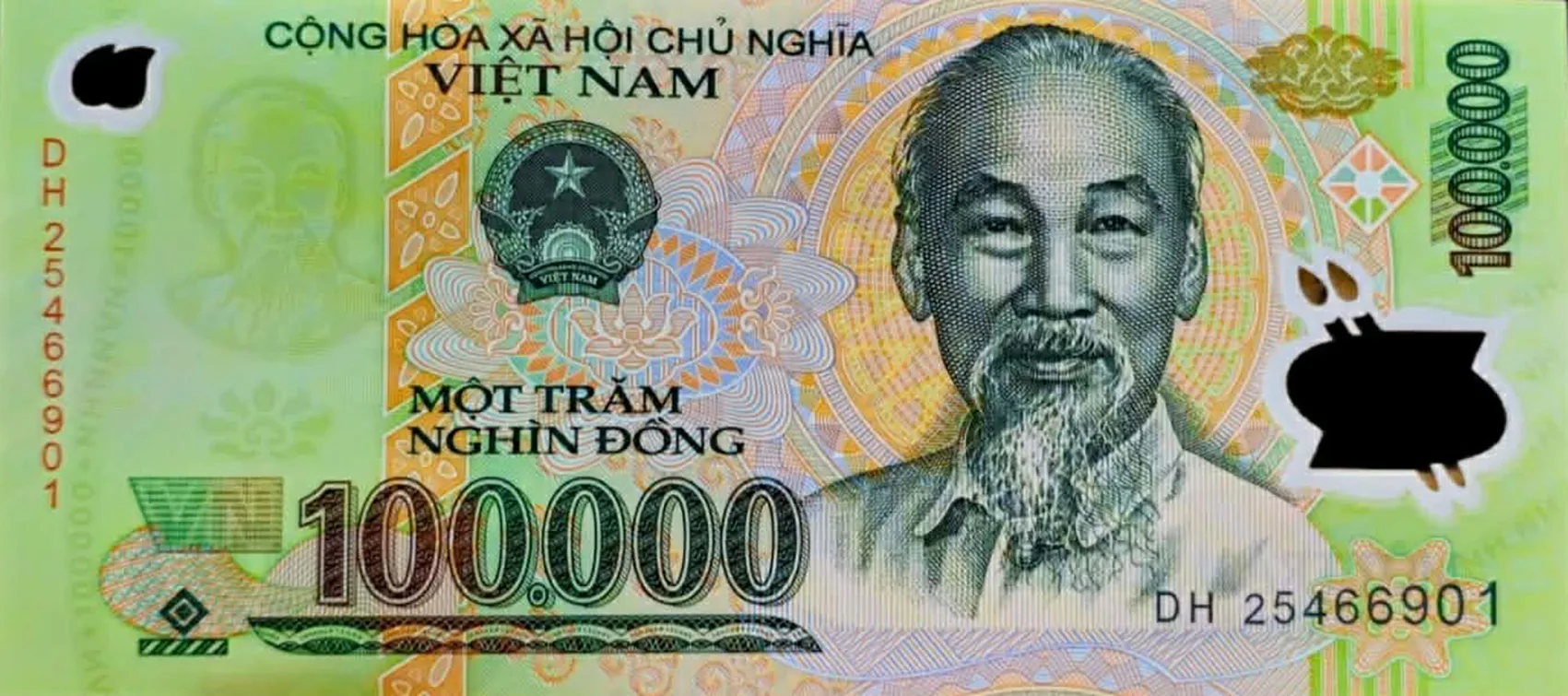
Cash in Vietnamese dong is still standard for street food, markets and small shops. Watch out for the 20,000 and 500,000 notes, which are a similar blue shade.

Cards work in cities
Visa and Mastercard are widely accepted at hotels, restaurants and shops in larger cities, and contactless payment is increasingly common.

Use bank ATMs and plan withdrawals
International cards work at ATMs nationwide, but local banks cap withdrawals lower than international ones. Withdraw extra cash before heading to rural areas with fewer ATMs.
| Month | High, °C | Low, °C | Rain, mm |
|---|---|---|---|
| January | 20.3 | 10.6 | 31.9 |
| February | 23.4 | 13 | 21.8 |
| March | 26.6 | 16.2 | 49 |
| April · best | 30.4 | 19.9 | 77.7 |
| May · best | 31.8 | 23.3 | 178.9 |
| June | 31.9 | 25 | 201.3 |
| July | 31.7 | 25 | 299.8 |
| August | 31 | 24.8 | 321.8 |
| September · best | 30.2 | 23.2 | 222.9 |
| October · best | 27.7 | 19.8 | 124 |
| November · best | 24.7 | 15.8 | 52.2 |
| December | 20.8 | 11.2 | 25.1 |
Monthly averages. Source: NASA POWER climatology, 2001-2020.
April · ideal
The best window runs April, May, September, October and November.
High 30.4°CLow 19.9°CRain 77.7 mm
Sweet spot: Hanoi has a cool, misty winter from December to March, a hot and humid rainy season from June to August, and its most comfortable weather in spring (April to June) and autumn (September to November).
Washington, D.C.
--:--:--
Hanoi
--:--:--
₫400,000($15.76)
Restaurants
Not part of Vietnamese custom, but appreciated, especially if service isn't already included.
0–10%
on a ₫400,000 bill: ₫0 · $0
Hotel porters and housekeeping
Per bag or per day, more common at higher-end hotels.
₫10,000–₫50,000
$0.39–$1.97
Taxis and ride-hailing
Rounding up the fare is common but not expected.
No tip expected
Private tour guides and drivers
Per day, more for multi-day tours.
₫50,000–₫150,000
$1.97–$5.91
Spas and salons
Increasingly expected in tourist areas.
5–10%
on a ₫400,000 bill: ₫20,000 · $0.79
Local SIM
RecommendedAirport arrival counters or shops of Viettel, Mobifone or Vinaphone in any city Usually the cheapest option, with wide 4G/5G coverage even outside major cities. Bring your passport to register the SIM.
eSIM
Online, before you travel, from an eSIM provider or your phone's own eSIM store Convenient if your phone supports eSIM, since you can activate it before landing without swapping a physical SIM.
Roaming
Activated through your home mobile provider before departure The simplest option but usually the most expensive; check your provider's Vietnam rates before you rely on it.

Get your Vietnam e-Visa in about ten business days, without the portal headaches
Upload a phone photo and your passport, we check them against every rule above, submit, and send your approval to your inbox. From $54 all-in.