eVisa
Tourist
Entry
Validity
60 days
- Processing
- 5–7 business days
- Total cost
- US$80



Nepal
Thailand

Yes.
Nepali citizens holding an ordinary passport need a Thai visa before travel. Apply online through Thailand's official e-Visa platform.
eVisa
Entry
Validity
60 days
 Pre-checked
Reviewed
Expert check before submission


5–7 business days
Processing time


 +21k
21K+
Applications processed
 Available now
24/7
Expert human assistance
Plusvisa is a private visa application service, not a government agency or embassy. Official government source: Thailand e-Visa (Ministry of Foreign Affairs), thaievisa.go.th.

Route
e-Visa, applied online
Required for Nepali applicants since 1 January 2025

Stay per visit
Up to 60 days
Tourist visas TR and MT

Passport
Valid 6 months
Thai rule counts from entry; the Kathmandu embassy asks 6 months before departure
Most people
For tourism only. Single entry (valid 3 months) or multiple entry (valid 6 months). Stay up to 60 days each visit. Apply on the official e-Visa platform.
Medical trips
For medical treatment in Thailand. Same e-Visa platform and up to 60 days each visit. Hospital records or a confirmed hospital appointment are needed.
Nepal issues ordinary, official and diplomatic passports. The destination rules treat official and diplomatic holders through separate diplomatic channels.
Ordinary passport
e-Visa neededApply for a tourist (TR) or medical (MT) e-Visa before travel. Up to 60 days each visit.
Official passport
Check with embassyThe Kathmandu embassy says official passport holders do not need a visa. The destination guide says they apply through diplomatic channels. Confirm with the embassy first.
Diplomatic passport
Diplomatic channelsApply through diplomatic channels, not the standard e-Visa platform.
| e-Visa | Validity | Processing | Government fee | All-in with Plusvisa* |
|---|---|---|---|---|
Tourist eVisa | Stay up to 60 days Multiple entry | 5–7 business days | US$201 | US$260 |
Tourist eVisa | Stay up to 60 days Single entry | 5–7 business days | US$41 | US$80 |
* The government fee is the government's own charge, never refundable. All-in adds Plusvisa's service fee, per traveller; it is refunded if we cause a refusal.
Nepali ordinary passport holders on a tourist (TR) or medical (MT) e-Visa may stay up to 60 days each visit. The limit applies per visit, not across a year.
Tourist: 60 days per visit.
Arrive 1 March
42 of 60 days
1 Mar – 11 Apr: 42 of the 60 days this visa allows in one visit.

Tourist (TR) and medical (MT): Stay up to 60 days each visit. Single entry is valid 3 months from issue. Multiple entry is valid 6 months from issue.

Extensions: A stay can be extended at an Immigration Bureau office inside Thailand. The officer decides. Extensions are not handled on the e-Visa platform.

Overstays: Overstaying is an offence under Thai immigration law. It can lead to a fine, detention or a ban on re-entry.

Work and study: Work, study or long-term stays need a visa for that purpose. The tourist e-Visa does not cover them.
Nine things to have ready before you start your application, as a Nepali applicant.

Valid at least 6 months. The destination guide counts from entry; the Kathmandu embassy counts from departure. Keep a copy of the biodata page.
Three recent passport-size photos of the applicant, as the embassy asks. Check the portal for the upload format.

Complete the form in full. The embassy asks for three completed forms; the portal may ask for one online form. Follow what the portal shows.

Shows enough funds for the stay. The embassy sets a minimum balance per person and a higher one per family. Check the Kathmandu embassy page for the current figures.
Confirmed hotel or address in Thailand, in the applicant's name, for the whole stay.
Confirmed airline ticket showing arrival and departure dates, plus a detailed plan of the trip in Thailand.

File online within 72 hours before arrival. It is separate from the visa.
Only for some visa types

Hospital records or appointment
Yellow fever certificate
Processing takes 5–7 business days. Enter your arrival date and we'll work backwards.
Processing
Pick your arrival date
Apply online
—
Form and uploads, about 30 min
Pay the fee
—
By card, on the portal
Processing
5–7 business days
Official estimate
Approval emailed
—
Keep a copy on your phone
Arrive in Thailand
—
Show the approval at the border
The Kathmandu embassy says apply at least a month before departure, but not more than 3 months before.
Do you hold an ordinary Nepali passport that is valid for at least 6 months?
Is your trip for tourism or medical treatment?
Will you stay 60 days or less on each visit?
Result
Answer all three
Three quick checks of the rules that most often catch travellers out, and we'll tell you where you stand.
Before you apply
Check the visa is needed
Ordinary Nepali passport holders need a Thai visa. Choose the tourist (TR) or medical (MT) e-Visa for your trip.

Official passport holders: see the passport types section.
Create an account
Register on the official Thai e-Visa platform with an email address. Activate the account through the link sent by email.
Gather your documents
Prepare your passport, photos, bank statement, accommodation, flight tickets and itinerary. Medical trips also need hospital records or an appointment.
See the documents section.
On the official portal
Fill in the application
Enter passport, personal, travel and accommodation details. Check every detail. Errors in names or passport numbers can lead to rejection.
Upload your documents
Upload the passport copy, photo and supporting files in the format the portal asks for. Check your email for requests for more documents.
Pay the fee
Pay the fee as the portal shows. The destination rules say the portal takes online payment, mainly by credit or debit card. The fee is not refunded once paid.

Kathmandu embassy says online payment is unavailable for Nepali applicants. Check before paying.
After you apply
Wait for a decision
The embassy says a decision can take several working days and sometimes longer in busy periods. Track the status on the portal.
Print your e-Visa
Once approved, you get a confirmation email. Print it and show it to the airline and at Thai immigration.
File the Digital Arrival Card
File the Thailand Digital Arrival Card online no more than 72 hours before you arrive. It is separate from the visa.
Official website: thaievisa.go.th (opens in a new tab)
Yes, if you hold an ordinary Nepali passport. The Royal Thai Embassy in Kathmandu says Nepali applicants must use the online e-Visa platform. Holders of official passports should check with the embassy.
On the official e-Visa platform at thaievisa.go.th. The Kathmandu embassy says in-person applications ended on 1 January 2025. Be careful with private sites that offer to process visas for a fee.
Up to 60 days each visit for tourist (TR) and medical (MT) visas. Extensions are handled by Immigration Bureau offices inside Thailand, at the officer's discretion.
The Kathmandu embassy says to apply at least a month before departure, but not more than 3 months before. Allow extra time for processing.
The embassy asks for a six-month bank statement. It sets a minimum balance per person and a higher one per family. Check the embassy's tourist visa page for current figures.
Yes. The destination rule counts six months from entry. The Kathmandu embassy asks for six months from departure. Renew your passport if it will expire within that time.
Yes. The Thailand Digital Arrival Card is a separate online form. File it within 72 hours before arrival, even with an approved e-Visa.
No. Work, study and long-term stays need a visa for that purpose. Speak to the Royal Thai Embassy in Kathmandu before you apply.
Visa sorted
The things that make the first
48 hours easy, compared with home
Type A
Two flat pins
Type B
Two flat pins · earthed
Type C
Two round pins · 2.5 A
Type O
Local standard
Type C
Type C is used both at home and in Thailand, so your own plugs fit — though you may meet the other types too.
Voltage
230 V · 50 Hz
Same as Nepal — phones, laptops and shavers work with only an adapter, no converter.

Pack: nothing special — your type C plugs go straight in. A small power strip is still handy where hotel rooms have one socket.
Compare traffic side:
Thailand · left-hand traffic — same as Nepal

Getting around
Bangkok has a Skytrain and metro that avoid traffic; elsewhere taxis, tuk-tuks and ride-hailing apps are common. Metered taxis and the BTS/MRT are usually the easiest options for visitors.

Health basics
Tap water is best avoided for drinking; bottled or filtered water is cheap and widely sold. Pharmacies are common for minor ailments, and hospitals in major cities are generally of a good standard.

Etiquette
Dress modestly and remove shoes when visiting temples, and avoid touching anyone's head or pointing your feet at people or Buddha images. The monarchy is treated with deep respect; avoid any disrespectful comments.
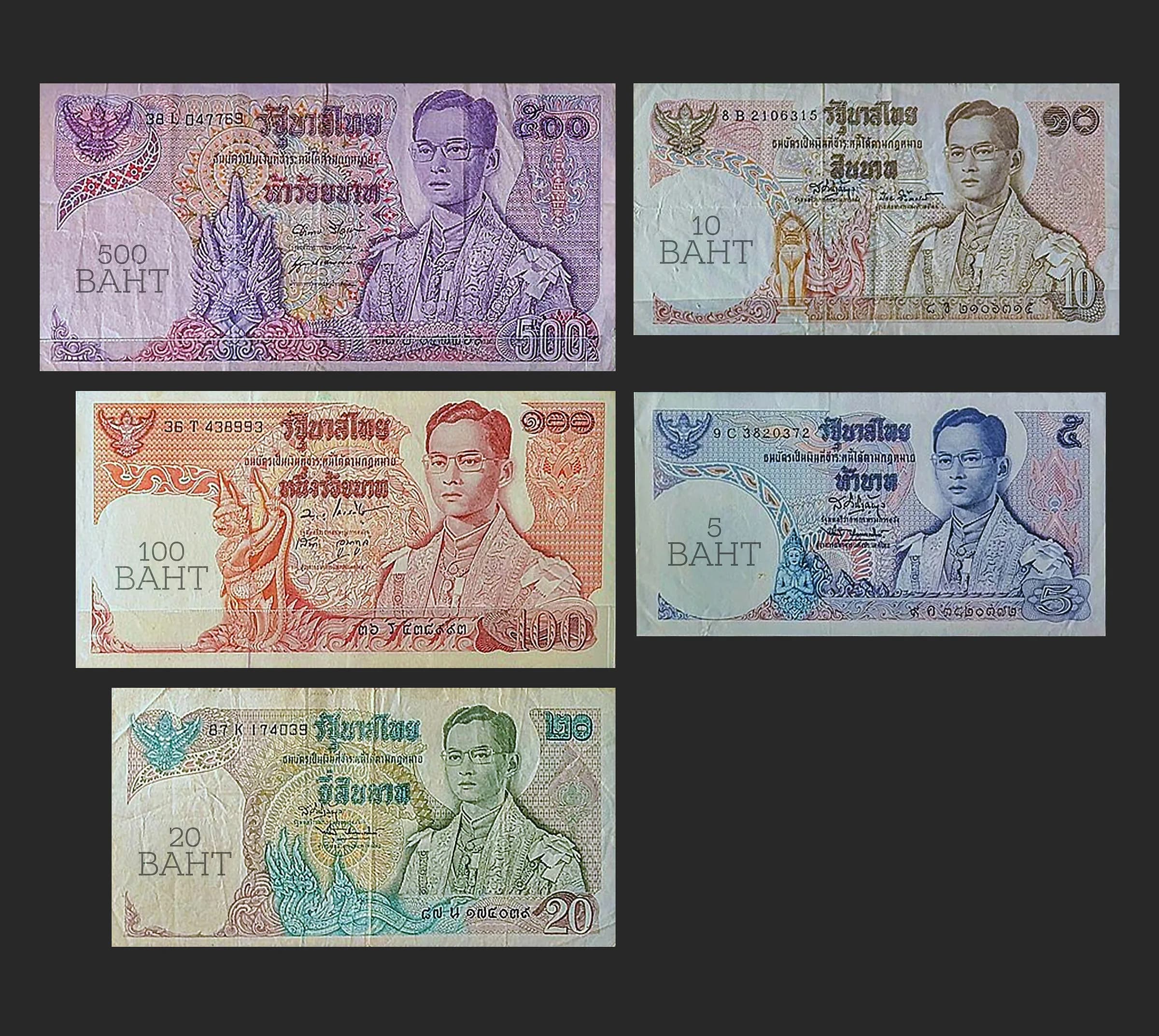
Thailand uses the Thai Baht (THB).

Cash is still useful
Street food, markets, small shops and tuk-tuks mostly take cash only. Keep small baht notes and coins on hand for everyday spending.

Cards work in cities
Hotels, malls and larger restaurants in cities and tourist areas accept credit and debit cards, but smaller towns and rural areas rely more on cash.

ATMs are widespread but charge a fee
ATMs are easy to find in cities and tourist areas and usually charge a fixed withdrawal fee on top of any charge from the home bank, so larger, less frequent withdrawals can work out cheaper.
| Month | High, °C | Low, °C | Rain, mm |
|---|---|---|---|
| January · best | 32.6 | 19.9 | 16.4 |
| February · best | 35.3 | 22.4 | 13.6 |
| March | 36.1 | 24.3 | 47.4 |
| April | 35.9 | 25.5 | 75.3 |
| May | 33.5 | 25.5 | 163.7 |
| June | 31.9 | 24.9 | 165 |
| July | 31.4 | 24.2 | 168.6 |
| August | 31.2 | 24 | 181.4 |
| September | 30.3 | 24.1 | 278.1 |
| October | 30.3 | 23.6 | 203.1 |
| November · best | 30.3 | 21.5 | 38.7 |
| December · best | 30.6 | 19.3 | 9.6 |
Monthly averages. Source: NASA POWER climatology, 2001-2020.
January · ideal
The best window runs January, February, November and December.
High 32.6°CLow 19.9°CRain 16.4 mm
Sweet spot: Bangkok is warm all year. November to February is the coolest and driest period and the busiest tourist season. March to May is hot and dry, June to August brings the start of the monsoon, and September to October is the rainiest period.
Kathmandu
--:--:--
Bangkok
--:--:--
Restaurant without service charge
Left on the table
฿20–฿40
Restaurant with service charge
A service charge on the bill usually replaces a tip
No tip expected
Massage or spa
Handed directly to the therapist
฿50–฿200
Metered taxi
Rounded up from the fare
฿10–฿20
Tuk-tuk
Fare is agreed in advance
No tip expected
Hotel bellboy or housekeeping
Per bag or per day
฿20–฿50
Private tour guide, full day
Per person
฿200–฿500
Local SIM
RecommendedConvenience stores, SIM counters at airports, and mobile operator shops Tourist SIM packages from Thai operators cover data for a set number of days.
eSIM
Purchased online before the trip and installed on an eSIM-compatible phone Useful for landing with data already active, without finding a shop.
Roaming
Activated through the traveller's home mobile provider Usually the most expensive option, but needs no setup on arrival.
Get your Thailand e-Visa in about seven business days, without the portal headaches
Upload a phone photo and your passport, we check them against every rule above, submit, and send your approval to your inbox. From US$80 all-in.