


Morocco Visa for Danish Citizens: Entry Rules
- No visa needed
- Verified
Plusvisa is a private visa application service, not a government agency or embassy. Official government source: Accès Maroc (e-Visa portal), acces-maroc.ma.

Visa-free stay
Up to 90 days
Per entry, counted from the arrival day

Passport validity
Cover 90 days from departure
Danish MFA advice. No fixed months rule published.

Extension
Up to 3 more months
Go to a police station at least 10 days before day 90, per Danish MFA. Later, you must leave to renew the stamp.
Two routes into Morocco
Most Danish travellers
Visa-free entry
No visa or e-Visa before you fly. You get an entry stamp on arrival and can stay up to 90 days for tourism or business, counted from the arrival day.
Staying longer or living there
Extension or residence permit
To stay past 90 days, ask the DGSN for an extension with a justified reason before the 90 days end. To live or work long-term, apply for a residence permit instead.
How long you may stay
Danish passport holders can enter Morocco visa-free and stay up to 90 days per visit. This limit applies per entry, not as a running total across the year, and it is separate from the e-Visa's 30-day limit, which only applies if you use that route instead.

90 days, visa-free: Danish citizens do not need a visa or e-Visa for tourism or business trips of up to 90 days. The Danish foreign ministry confirms this is visa-free entry, not an e-Visa.

The count resets per entry: Each new entry to Morocco starts a fresh 90-day count. It is not a cumulative limit across several visits in the same year.

Extensions need a justified reason: To stay longer, apply to Morocco's immigration and national security authority, the Direction Générale de la Sûreté Nationale, before your 90 days end. An extension cannot take the total stay beyond a further three months.

Overstaying has real consequences: Staying beyond 90 days is an immigration offence. Morocco punishes this with a fine and expulsion, which can come with a ban on re-entry.
Your document checklist
Five things to have ready before you start your application, as a Danish applicant.

Valid passport
The Danish Foreign Ministry recommends at least 90 days of validity left from your departure date into Morocco. The passport must not be damaged.

Return or onward ticket
Border police can ask to see your return or onward flight ticket on arrival.
Proof of funds
Be ready to show you can support yourself during the stay, for example a bank statement or cash.

Travel insurance
Cover for hospitalisation and repatriation. Danish public healthcare cover and the EU health card do not apply in Morocco.
Only for some visa types

Parental authorisation letter
Only if Travellers under 18 travelling without both parents. A letter from both holders of parental responsibility, if a child travels with only one parent or with someone else's child.
Questions Danish travellers actually ask
No. Danish passport holders can enter Morocco visa-free for tourism or business trips of up to 90 days. You do not need to apply for a visa or an e-Visa before travelling.
No. The e-Visa is for nationalities that are not visa-free. As a Danish citizen you already qualify for 90 days visa-free, which is longer than the e-Visa's 30-day single-entry stay.
Extensions are not automatic. You need to apply to Morocco's immigration and national security authority, the Direction Générale de la Sûreté Nationale, with a justified reason, before your 90 days run out. The total stay cannot go beyond a further three months.
Overstaying is an immigration offence in Morocco. It can lead to a fine and expulsion, and in some cases a ban on re-entry.
Danish authorities recommend your passport stays valid for at least the full length of your visa-free stay, 90 days from your departure date. No separate minimum validity in months is published for Moroccan entry.
A Danish emergency passport is recognised by Moroccan authorities only for leaving Morocco, not for entering. An EU emergency travel document is not recognised at all. Check with the Moroccan embassy before you travel if this applies to you.
Yes. If a child is travelling without both parents, or alone, it is recommended to carry written consent from the holders of parental authority. Moroccan border staff may ask for this.
Yes. Even though you do not need a visa, you can be asked to show a return or onward ticket and proof you can support yourself for the stay, like any other non-resident traveller.
No. The land border between Morocco and Algeria is closed to everyone, regardless of nationality or visa status. It cannot be used to enter or leave Morocco.
Visa sorted
The things that make the first
48 hours easy, compared with home
Your Danish plug fits. Here's what to expect.
Type C
Two round pins · 2.5 A
Type E
Two round pins · 16 A
Type C
Type C and E sockets are used both at home and in Morocco, so your own plugs fit.
Voltage
220 V · 50 Hz
Against 230 V · 50 Hz at home. Check the label on chargers and appliances: anything marked 100–240 V, 50/60 Hz works in both.

Pack: nothing special — your type C and E plugs go straight in. A small power strip is still handy where hotel rooms have one socket.
Morocco drives on the right — just like home
Compare traffic side:
Morocco · right-hand traffic — same as Denmark

Getting around
ONCF trains link the main cities fast and comfortably. Metered 'petit taxis' work within cities, while shared 'grand taxis' or buses cover longer routes. Hiring a car suits trips into the Atlas Mountains or desert.

Health and insurance
No vaccines are mandatory for most travellers, though routine and hepatitis A/B cover is often advised. Morocco's e-Visa rules expect travellers to carry health and repatriation insurance, so arrange this before you go.

Customs and etiquette
Dress modestly away from beaches and resorts, ask before photographing people, and expect reduced hours at restaurants and shops during Ramadan.
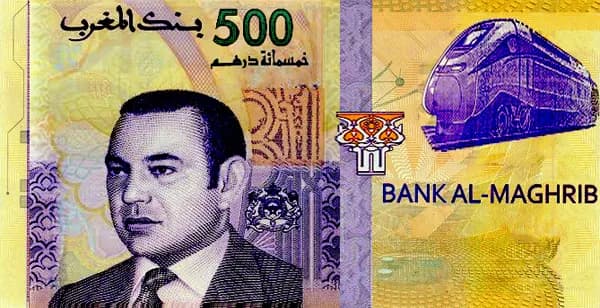
Moroccan Dirhams, cash and cards
Morocco uses the Moroccan Dirham (MAD).

Currency controls apply
Taking Moroccan dirhams out of the country is capped at 1,000 MAD. Bringing in or taking out foreign banknotes worth 100,000 MAD or more must be declared to customs on arrival.

ATMs are easy to find in cities
Cash machines are common in Rabat, Casablanca, Marrakech and other cities, but carry enough cash before heading into the mountains, desert or small towns.

Cash still rules day to day
Cards are accepted at hotels, bigger shops and restaurants, but markets, taxis and tips are usually cash-only, so keep small dirham notes on hand.
Weather by month (Rabat)
- Daytime high
- Grey row = night low
- Best time to go
- Daytime high
- Grey row = night low
- Best time to go
| Month | High, °C | Low, °C | Rain, mm |
|---|---|---|---|
| January | 16.6 | 10.8 | 65.7 |
| February | 17.2 | 10.8 | 52 |
| March · best | 19 | 12 | 55.2 |
| April · best | 20.4 | 13.5 | 37.5 |
| May · best | 23.1 | 15.7 | 18.6 |
| June | 25.6 | 18.2 | 2.7 |
| July | 27.3 | 19.7 | 1.6 |
| August | 28.3 | 20.6 | 2.5 |
| September · best | 26.5 | 19.5 | 33.3 |
| October · best | 24.4 | 17.7 | 54.6 |
| November · best | 20.2 | 14.4 | 98.1 |
| December | 17.8 | 12.1 | 67.3 |
Monthly averages. Source: NASA POWER climatology, 2001-2020.
March · ideal
The best window runs March, April, May, September, October and November.
High 19°CLow 12°CRain 55.2 mm
Sweet spot: Rabat has a Mediterranean-Atlantic climate: mild, wetter winters and warm, dry summers. Spring and autumn bring comfortable temperatures for sightseeing, while summer can get hot and winter brings most of the rain.
One time zone
Copenhagen
--:--:--
Rabat
--:--:--
How much to tip, in DKK
MAD 2,000
Restaurant bill
Leave cash even if a service charge is included
10–15%
on a MAD 2,000 bill: MAD 200
Cafe
MAD 2–MAD 10
Hotel porter
Per bag
MAD 10–MAD 20
Housekeeping
Per night
MAD 10–MAD 20
Petit taxi
Round up the metered fare
MAD 5–MAD 10
Grand taxi (shared, fixed price)
No tip expected
Tour guide, full day
Per person
MAD 100–MAD 200
SIM, eSIM or roaming?
Local SIM
RecommendedLocal prepaid SIM
≈ MAD 200
Maroc Telecom, Orange or Inwi counters at airports and in city shops; passport required to register Roughly 200 MAD for a data bundle around 50 GB; prices vary by operator and plan
eSIM
Travel eSIM
International eSIM providers' apps or websites, installed before you fly Convenient for short trips or late arrivals, usually no passport needed, but typically less data per dirham than a local SIM
Roaming
Roaming on your home plan
Activate through your home network before departure Simplest option but usually the most expensive for data-heavy use