


Madagascar Visa for Japanese Citizens: Rules and Applying
- Visa on arrival
- Apply 3–180 days before arrival
- Verified
Plusvisa is a private visa application service, not a government agency or embassy. Official government source: eVisa Madagascar, evisamada.gov.mg.
Table of contents

Passport
Valid 6 months after arrival
Also 2 blank pages

Tourist stay
Up to 90 days in total
Tourist visits only

Where to get it
Airport or embassy in Japan
Japan's government advises getting it in advance
Three routes into Madagascar
Most travellers
Visa on arrival
A tourist visa for up to 90 days, bought at Madagascar's international airports on arrival. Pay in cash or by card. Japan's government notes that the airport queue can take time.
Advance option
Tourist visa from the embassy in Tokyo
Apply in advance at the Embassy of Madagascar in Japan. Japan's government recommends this where possible, to avoid airport delays.
Study, work or business
Long-stay visa from the embassy
Long-stay visas must be applied for at the Embassy of Madagascar in Japan before you travel. They are not sold at the airport.
How long you may stay
A tourist visa allows a stay of up to 90 days in total in Madagascar. This is the limit for a Japanese passport holder on a tourist trip.

Tourist visa: up to 90 days: The tourist visa covers up to 90 days in total. This is the same limit for Japanese citizens as for everyone else on this visa.

Extending your stay: The destination guide says a stay can be extended at the Immigration office, up to 90 days in total. Japan's government notes that short-stay visas are normally not extended. Plan your full stay before you fly.

If you plan to extend: Japan's government advises that anyone planning to extend or change their visa after arrival should ask the embassy in advance about a transformable visa, before entering.

Long stays and other purposes: Study, work, business and family visas are long-stay visas. Apply at the Embassy of Madagascar in Japan before you travel. The 90-day tourist limit does not apply to them.

Overstaying: Overstaying can lead to detention or deportation. Japan's government warns against paying agents who offer to extend stays for a fee, as some issue fake permits.
Your document checklist
Six things to have ready before you start your application, as a Japanese applicant.

Passport
Valid for at least 6 months after arrival, with at least 2 blank pages. Must not be reported lost or stolen.

Arrival (entry) card
Fill in by hand. It may not be handed out on the plane, so pick one up before the immigration gate. Do not pay anyone to fill it in.

Return or onward ticket
Proof that you will leave Madagascar. Immigration asks to see it on arrival.
Payment for the visa
Card for the online application. On arrival, cash or card.
Only for some visa types

Passport-size photo
Only if Paper application only. Two recent passport-size photos, for the paper application form used on arrival or at the embassy.Yellow fever certificate
Only if Recent travel to a yellow fever area. Needed only if you have been in a country with yellow fever risk. Japan's government notes that yellow fever certificates are valid for life since 2016.
When should you apply?
Enter your arrival date and we'll work backwards.
Processing
Pick your arrival date
- 1
Apply online
—
Form and uploads, about 30 min
- 2
Pay the fee
—
By card, on the portal
- 3
Processing
See the portal
Official estimate
- 4
Approval emailed
—
Keep a copy on your phone
- 5
Arrive in Madagascar
—
Show the approval at the border
Figures from the destination guide. Japan's government advises getting the visa from the embassy in Japan in advance, where possible, to avoid airport queues.
Four questions, 20 seconds
Is your trip a tourist visit of 90 days or less?
Is your passport valid for at least 6 months after your arrival date, with 2 blank pages?
Do you have a return or onward ticket?
Have you been in a yellow fever or Ebola-affected country in the last 21 days?
Result
Answer all four
Four quick checks of the rules that most often catch travellers out, and we'll tell you where you stand.
The application, step by step
Before you apply
- 1
Check your passport and ticket
Your passport must be valid for at least 6 months after arrival, with at least 2 blank pages. Carry a return or onward ticket.
- 2
Decide where to get the visa
You can buy the tourist visa on arrival at the airport. Japan's government advises getting it in advance from the Embassy of Madagascar in Japan where possible.
Long-stay visas must be arranged at the embassy before travel.
- 3
Check the health rules
Carry a yellow fever certificate only if you have been in a risk area. Check current Ebola and other health notices before you fly.
After you apply
- 4
Fill in the arrival card
Complete the entry card by hand at the immigration gate if none was handed out on the plane. Show your passport, entry card and return ticket.
- 5
Register your trip
For stays under 3 months, register with Japan's Tabi-Regi service for safety alerts. For stays of 3 months or more, file a Zairyu Todoke with the Japanese embassy.
Official website: evisamada.gov.mg (opens in a new tab)
Questions Japanese travellers actually ask
Yes. Japan's government says a visa is required. A tourist visa for up to 90 days can be bought at the airport on arrival.
Yes, for short stays of up to 90 days. Japan's government notes that the airport immigration queue can take time, so getting the visa in advance is better where possible.
Apply at the Embassy of Madagascar in Japan. Japan's government recommends this for tourist visas where possible. Long-stay visas must be applied for at the embassy before travel.
A tourist visa allows up to 90 days in total. Long-stay visas for study, work, business or family are separate.
The destination guide says you can extend up to 90 days in total at the Immigration office. Japan's government notes that short-stay visas are normally not extended. If you plan to extend, ask the embassy in advance about a transformable visa.
Yes. Your passport must be valid for at least 6 months after arrival and have at least 2 blank pages.
Only if you have been in a country with yellow fever risk. Japan's government notes that such certificates are valid for life.
Japan's government lists cash or card on arrival. Card payment is also possible on the official online application.
Visa sorted
The things that make the first
48 hours easy, compared with home
Your Japanese plug won't fit. Here's what will.
Type C
Two round pins · 2.5 A

Type D
Three round pins · 5 A
Type E
Two round pins · 16 A
Type J
Three round pins · 10 A
Type K
Three round pins · 16 A
Type C
Madagascar uses type C, D, E, J and K sockets and your plugs are type A and B. An A-to-C adapter works for the whole trip.
Voltage
220 V · 50 Hz
Against 100 V · 50 Hz at home. Check the label on chargers and appliances: anything marked 100–240 V, 50/60 Hz works in both.

Pack: one type C adapter and a small power strip — hotel rooms rarely have more than two sockets.
Madagascar drives on the right — the opposite of home
Compare traffic side:
Madagascar · right-hand traffic — the opposite of Japan

Getting around
Roads are slow and often rough outside the capital, so internal flights or a private driver are common for longer distances. Public taxi-brousse minibuses link towns but take much longer than the map suggests.

Health
Medical facilities are limited outside Antananarivo. Bring any regular medication, consider malaria prevention, and check vaccination advice, including yellow fever if arriving from an at-risk country.

Customs and etiquette
Many places observe local taboos known as fady; ask a guide before taking photos of people, sacred sites or tombs, and dress modestly in villages.
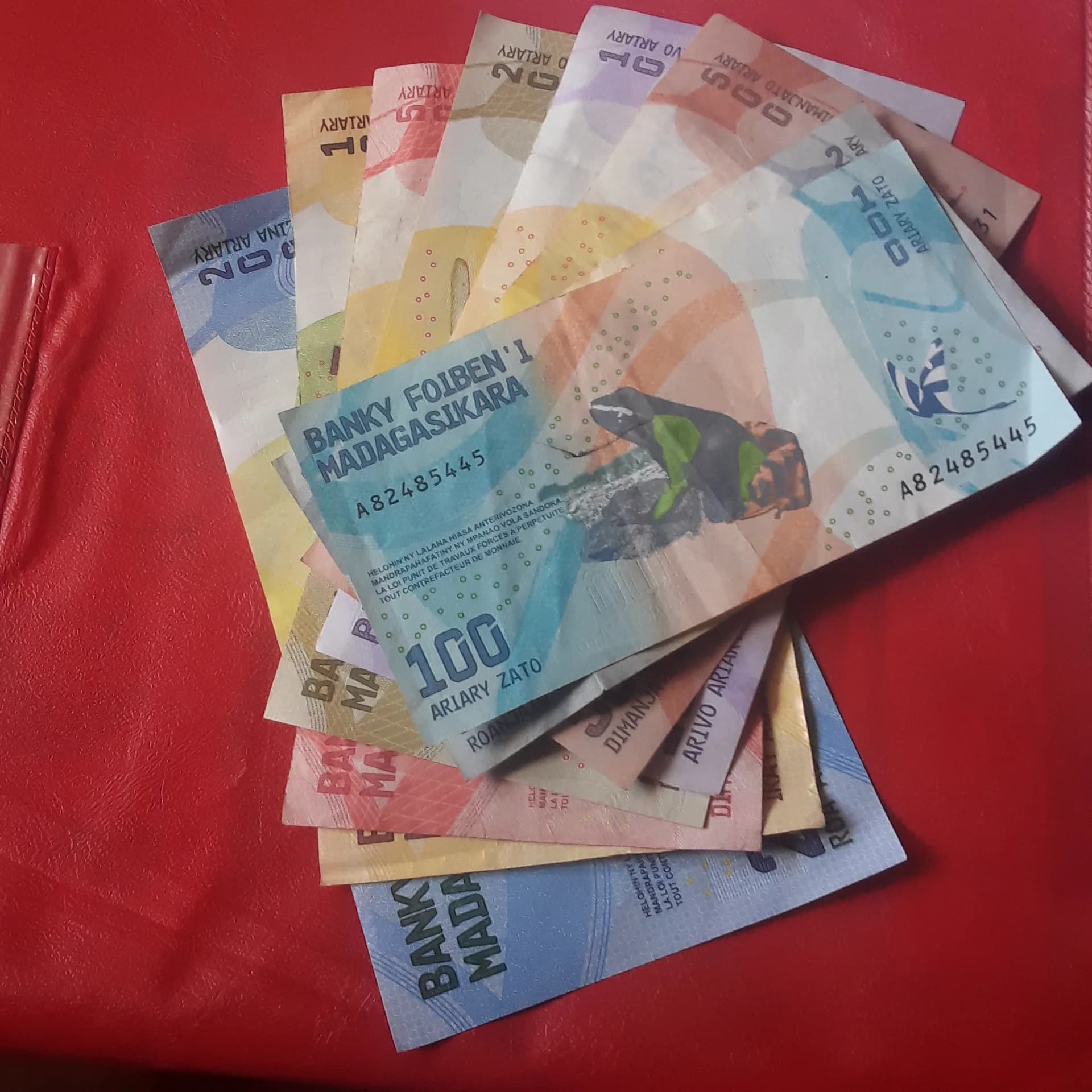
Malagasy Ariarys, cash and cards
Madagascar uses the Malagasy Ariary (MGA).

Cash is king
Madagascar runs largely on cash, especially outside the capital. Carry small ariary notes for taxis, markets, guides and tips.

Cards have limits
Cards are accepted at some hotels, airlines and larger restaurants in Antananarivo and tourist hubs, but many smaller businesses and rural areas take cash only.

ATMs thin out fast
ATMs are reliable in the capital and provincial centres but scarce or unavailable in small towns, so withdraw enough before heading to remote areas.
Weather by month (Antananarivo)
- Daytime high
- Grey row = night low
- Best time to go
- Daytime high
- Grey row = night low
- Best time to go
| Month | High, °C | Low, °C | Rain, mm |
|---|---|---|---|
| January | 23.2 | 15.3 | 474.6 |
| February | 23.1 | 15.2 | 378.8 |
| March | 22.6 | 14.7 | 304.4 |
| April · best | 21.7 | 13.1 | 159.3 |
| May · best | 19.8 | 11.2 | 85.6 |
| June · best | 17.4 | 9 | 84 |
| July · best | 16.6 | 8.2 | 85.3 |
| August · best | 17.9 | 8.3 | 58.3 |
| September · best | 20.2 | 9.4 | 46.5 |
| October · best | 22.8 | 11.6 | 96.4 |
| November | 23.9 | 13.6 | 222.3 |
| December | 23.9 | 14.9 | 388.1 |
Monthly averages. Source: NASA POWER climatology, 2001-2020.
April · ideal
The best window runs April, May, June, July, August, September and October.
High 21.7°CLow 13.1°CRain 159.3 mm
Sweet spot: Antananarivo has a warm, wet season from November to March and a cooler, drier season from April to October. The drier months, especially April to October, are generally the most comfortable for travel in the highlands.
One time zone
Tokyo
--:--:--
Antananarivo
--:--:--
How much to tip, in JPY
Ar 2,000
Restaurant bill
Where service is not already included
5–10%
on a Ar 2,000 bill: Ar 100
National park guide (per group, per day)
Ar 20,000–Ar 50,000
Driver-guide (per day, from the group)
Ar 25,000–Ar 40,000
Hotel housekeeping (per night)
Ar 5,000–Ar 10,000
Airport or hotel porter (per bag)
Ar 2,000–Ar 5,000
Taxi with meter
No tip expected
SIM, eSIM or roaming?
Local SIM
RecommendedLocal SIM card
Telma, Orange or Airtel counters at the airport or in town, with your passport for registration Usually the cheapest way to get data once you are in the country.
eSIM
Travel eSIM
Installed online before you travel, from an eSIM provider Convenient if your phone supports eSIM and you want data working the moment you land.
Roaming
Roaming from home
Activated through your home network before departure Usually the most expensive option; check your operator's Madagascar rates first.